Key Points
- The headline figures on AI and job losses — 30%, 50%, 80% — often come from studies measuring the exposure of tasks to AI. Getting from these task-level estimates to the overall impact on the economy often involves naive assumptions.
- The economics literature offers a clearer framework for thinking about this: AI destroys some jobs (displacement) but also creates new ones (reinstatement). The net effect depends on which force dominates, and history suggests economies eventually self-correct — but the transition can be painful and prolonged.
- The impact is likely to follow a J-curve: modest near-term disruption as firms experiment, followed by deeper structural change as they reorganise around AI.
- At the level of the firm, creative destruction will likely see some firms adapting quickly, or entering the sector, and rapidly gaining market share at the expense of slower-moving incumbents.
- At a regional level, the pace of change will depend on the existing industrial mix in the area - with some industries seeing larger transformation than others- and the pace of adaptation of local firms.
- The research that matters most right now is not about whether jobs are at risk, but which jobs, when, and how workers, firms and governments should be preparing. This is where the task-based evidence can be a really useful tool.
The headline problem
Pick up any report on AI and the labour market and you are likely to find an alarming number. Thirty per cent of jobs could be automated. Eighty per cent of workers have at least some tasks exposed to large language models. Three hundred million jobs globally are at risk. The numbers vary, but the tone is consistent: something very large is about to happen.
These figures are often based on interesting research on the ability of AI, often specifically large language models (LLMs), to undertake specific tasks. Given how well AI can undertake a wide range of tasks, it is easy for some commentators to work out the proportion of tasks in a job that are exposed to AI and arrive at large numbers for the impact on jobs.
This approach has some obvious flaws. That AI can in some sense do 40% of my tasks by hours does not mean my employer can immediately bump me down to a 3-day week. More subtly, if there are jobs that can be automated away, saving firms lots of money, where does that money go? These subtler questions call for a wider assessment of the impact of AI on the labour market.
Two forces: displacement and reinstatement
A popular framework for thinking about this has been provided by the economists Daron Acemoglu and Pascual Restrepo, whose work on automation and labour markets has become the standard reference in the field.2 They identify two competing forces.
The first is the displacement effect. When AI automates tasks previously performed by workers, it directly reduces labour demand in the affected occupations. This is the channel captured by the headline exposure figures, and it is the one that dominates public discussion. Unlike previous waves of automation that primarily displaced routine manual and cognitive tasks, AI has the potential to automate non-routine cognitive work across a much broader occupational spectrum — which is why the current wave feels different.
The second is the reinstatement effect. The money saved in automating some tasks ultimately gets spent on other things, creating demand for labour in new tasks and occupations. Acemoglu and Restrepo identify reinstatement as the dominant force offsetting automation over the past century. The mechanism is intuitive: as machines replace humans in some tasks, the cost of those tasks falls, the relative cost of human labour in other tasks also falls, and humans adapt to provide services that are not in competition with machines. New roles emerge. The economy finds a new equilibrium.
Their model includes a third channel: the rise of the AI industry itself. The development of AI models, the infrastructure required to run them, and the consultancy services associated with advising firms on adoption all create jobs directly.
The net impact on employment depends on the relative strength of displacement and reinstatement. Despite their finding that economies have historically self-corrected, Acemoglu and Restrepo argue that AI may generate weaker reinstatement effects than previous technologies, at least in the short to medium term — such that the economy might settle into a new balance with a smaller share of work done by humans. This is not a prediction of mass unemployment, but it is a prediction that the adjustment could be slower and more painful than in previous technological transitions.
The J-curve: why timing matters
If the Acemoglu-Restrepo framework tells us what the end state might look like, it says less about how we get there. A useful complement comes from Erik Brynjolfsson and co-authors, who propose that the economic impact of AI will follow a J-curve pattern.3
In an initial phase, there is heavy investment in AI and considerable hype about its transformative potential, but the impact on actual production is modest. Workers and firms experiment with how best to use the technology. Productivity gains are real but small, because the existing organisation of work was not designed around AI.
Over time, complementary investments in skills and tools allow workers to get more out of AI at an individual level. Then comes a deeper wave of change: firms re-engineer their organisational structures and production processes to make the most of the new technology. This is when the large productivity gains — and the large labour market disruptions — arrive.
This pattern has clear parallels with previous general-purpose technologies. Electricity was available from the 1880s, but it took decades for factories to be redesigned around electric motors rather than the steam-driven belt-and-shaft systems they replaced. The personal computer was widely adopted in the 1980s, but the productivity gains that Solow famously said were "everywhere except in the statistics" did not show up until the late 1990s, after firms had reorganised their workflows around the new technology.
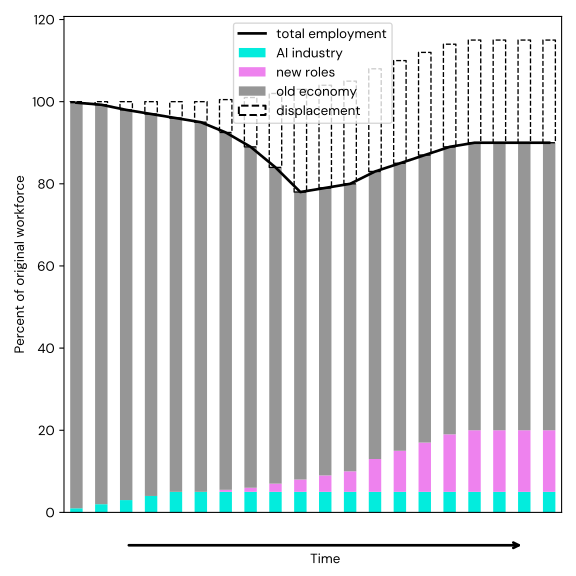
Bringing these two ideas together, we might expect the impact of AI on the labour market to look something like Figure 1. In a first phase, there is excitement about AI and heavy investment in AI technology and infrastructure, but relatively modest impact on workers in other industries. As firms begin to automate existing work, certain jobs in the old economy start to be displaced — beginning with the roles comprising tasks most readily automated, but progressing to a broader set of occupations as innovation makes AI useful for a wider range of tasks and firms make the complementary investments needed to re-engineer their production processes. At this point, employment falls as the displacement effect dominates. Finally, new roles begin to emerge and partially or fully offset the lost jobs.
We are, in early 2026, most likely still in the first phase — or at the beginning of the transition to the second. For most firms and regions, the real disruption lies ahead. The next section turns to what that disruption might look like and tees up the next two articles in the series, which explore what we might do about it.
From the economy to the firm and the region
The framework above describes the impact of AI on an economy as a whole. But economies are made up of firms, and the adjustment process at the firm level is messier than suggested by the aggregate picture.
Consider a particular industry — say, banking. AI may be used to replace humans in areas like customer service and compliance. The first steps could happen through experimentation with AI tools by existing staff in existing roles. Some firms may then re-engineer processes more ambitiously, creating new AI-specialist roles and reducing costs. If successful, they compete more effectively, win market share and may even expand their workforce. But it is equally possible that new entrants — built around AI from the start — emerge and rapidly take market share from incumbents, some of which then shrink or fail entirely. This is the logic of creative destruction: the aggregate displacement and reinstatement effects play out through a process of winners and losers at the firm level, not through a uniform adjustment across the industry.
This matters because it is impossible to predict, looking at any individual firm, whether it will be a fast adopter that gains market share or a slow mover that loses it. From the outside, the best one can say is that the industry-level outcome will reflect some mix of both — but the path there will involve considerable turbulence for individual firms and their workers.
At the regional level, the national-level forces play out differently depending on the local industrial mix. An area with a workforce concentrated in logistics, construction and care face different near-term challenges to one with large concentrations of administrative, financial and professional services work. The national-level framework is a useful starting point, but the specific impact on any given place depends on which industries are present, how exposed those industries' occupations are, and how quickly local firms adapt. The next article in this series explores what a place-based analysis looks like in practice and the third article in the series examines how firms themselves can adapt. Both of them draw on the task-based literature that this article started with, but interpreted with care.
Using task-based evidence, with care
The frameworks above tell us about macro dynamics. If we want to think through what this means for an individual firm or region today, we need tools to identify which occupations face exposure, when, and through what channels. This is where the task-based research becomes valuable - not as a predictor of overall job losses, but as an input to a bottom-up exercise in thinking through likely impacts and optimal responses.
Most task-based studies start from a database of tasks — typically O*NET in the United States or ISCO-08 internationally — and seek to assess the suitability of each task to being performed by AI. The methods vary: some survey job-holders, some consult labour market or AI experts, and some use language models themselves to evaluate task descriptions. Having scored each task, researchers aggregate over all the tasks in a job to produce an occupational exposure score.
Figure 2 gives an example from a prominent study by Gmyrek et al, mapped to the UK labour market and simplified a little. The Y axis measures the average task-level exposure to AI for each occupation, while the colour scheme corresponds to the different levels of risk of displacement that jobs face. This depends on average task exposure, but also makes an attempt to distinguish between where AI might augment a task rather than automate it away. In the scenario analysis in the next article in this series, only jobs in the Level 4 risk bucket are considered to be at immediate risk of displacement. The size of the bubbles reflects the share of total UK employment in each occupation.
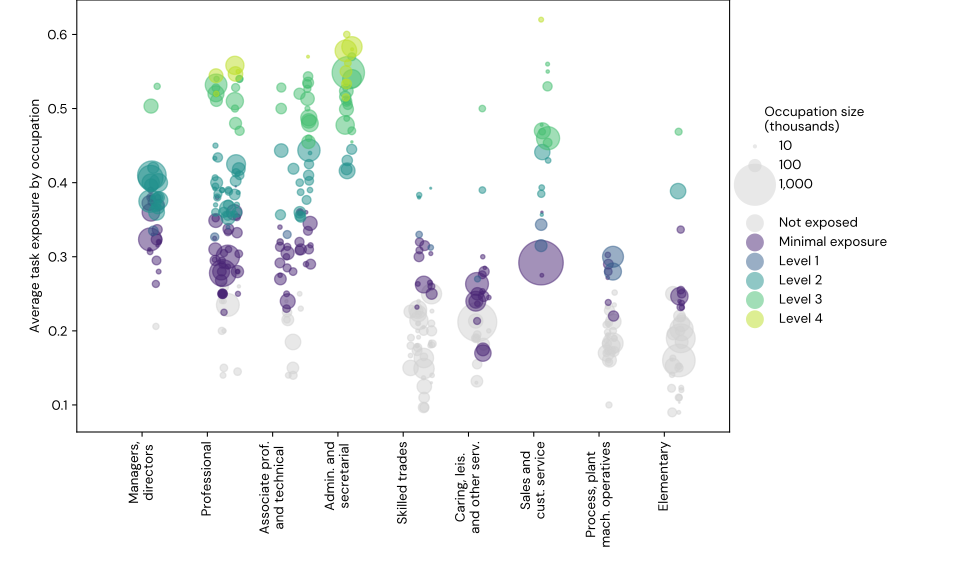
Sources: Gmyrek et al (2025), author's calculations. Details available on request.
Across the major studies, a reasonably consistent picture emerges. Clerical and administrative occupations face the highest automation risk — roles like data entry, bookkeeping, and general office administration, in which a large share of tasks involve processing structured information in predictable ways. Professional and semi-professional occupations — particularly in IT, finance and legal services — face high exposure, but a greater share of this is likely to take the form of augmentation rather than outright displacement, at least in the near term. Roles requiring physical presence, manual dexterity or direct human interaction — care work, construction, hospitality — are the least exposed.
There is a striking distributional pattern here. Unlike previous waves of automation, which disproportionately affected lower-paid manual and routine cognitive workers, AI exposure skews towards higher-educated, higher-paid, and disproportionately female workers.6 Administrative and secretarial work, for instance, is roughly 80% female in the UK. This has important implications for the design of policy responses.
What the evidence says so far
If AI is going to reshape the labour market, is there any sign of it yet? The short answer is: not much in the aggregate data, but some suggestive signals in the detail.
Unemployment rates for workers in highly exposed occupations have not diverged meaningfully from those in less exposed occupations since the launch of ChatGPT. Aggregate wages and employment levels do not yet show a clear AI signature. This is consistent with the J-curve story: we are still in the experimentation phase, before the organisational restructuring that will drive the larger effects.
Look more closely, however, and the picture gets more interesting. New job ads have slowed more for more exposed occupations. And there are clear patterns in the types of roles for which firms are recruiting people with AI skills. These vary across firms and industries, in a manner that is suggestive of the different approaches different firms are taking to AI adoption.
A companion article in this series presents our own analysis of vacancy data, examining who is hiring for AI skills, in which roles, and how advertised wages in exposed occupations are evolving.
What this means for policy — and practice
The combination of the Acemoglu-Restrepo framework, the J-curve thesis, and the task-based evidence points to a challenging but navigable landscape. The risks are real but not yet realised. The window for proactive planning is open but will not stay open indefinitely.
For regional and local government, the most valuable step is to understand the specific occupational profile of your area. The same technology will hit different places very differently, depending on the mix of industries and occupations, the demographic profile of exposed workers, and the availability of retraining pathways. Generic national-level exposure figures are a poor guide to local policy. The next article in this series explores what a place-based analysis looks like in practice.
For firms, the question is not whether to adopt AI but how to reorganise around it. The companies that treat AI as a tool to bolt on to existing processes will capture a fraction of its value. Those that rethink how work is structured — which tasks belong together, which can be delegated to machines, which new capabilities become possible and how their vendor relationships evolve — will capture far more. A later article sets out a framework for approaching this.
Notes
- The accountancy example is illustrative. Autor (2015) discusses this and other cases in "Why Are There Still So Many Jobs? The History and Future of Workplace Automation," Journal of Economic Perspectives, 29(3), 3–30. ↩
- Acemoglu, D. and P. Restrepo (2019). "Automation and New Tasks: How Technology Displaces and Reinstates Labor." Journal of Economic Perspectives, 33(2), 3–30. See also Acemoglu, D. and P. Restrepo (2018). "Artificial Intelligence, Automation and Work." NBER Working Paper No. 24196. ↩
- Brynjolfsson, E., D. Li, and L. Raymond (2023). "Generative AI at Work." NBER Working Paper No. 31161. ↩
- Eloundou, T., S. Manning, P. Mishkin, and D. Rock (2023). "GPTs are GPTs: An Early Look at the Labor Market Impact Potential of Large Language Models." arXiv:2303.10130. ↩
- Gmyrek, P., J. Berg, and D. Bescond (2025). "The jobs and skills implications of generative artificial intelligence." ILO Working Brief 17. ↩
- Gmyrek et al. (2025) find that women are roughly twice as exposed as men in high-income countries, driven largely by the concentration of women in clerical and administrative roles. Pizzinelli et al. (2023) at the IMF report a similar finding across a wider set of countries. ↩