Key Points
- The impact of AI on a region depends on its occupational profile. Areas with high concentrations of administrative and clerical work face a very different challenge from those dominated by health, construction or logistics.
- First-round displacement is only part of the story. When displaced workers compete for safe jobs, they create spillover pressure on occupations that are not themselves directly at risk — including roles that are themselves not directly affected by AI.
- Retraining pathways vary enormously by occupation. For some exposed workers, comparable-pay safe destinations are reachable with modest training. For others — such as administrative workers — the nearest safe options involve significant pay cuts unless substantial retraining is undertaken.
- The most robust policies are those that work across a range of scenarios: AI literacy training, education about the changes that are underway, targeted retraining for the most exposed groups, and monitoring systems that allow policy to adapt as the picture evolves.
Why place matters
The previous article in this series set out a general framework for thinking about AI and the labour market: displacement versus reinstatement, the J-curve of adoption, and the task-based approach to measuring occupational exposure. This article applies that framework in a regional context.
A combined authority with a workforce concentrated in logistics, construction and care faces a very different challenge from one with large concentrations of administrative, financial and professional services work. The first may see relatively little near-term disruption from AI; the second could see significant displacement in occupations that employ a large share of its residents. The national average is a poor guide for either.
This article illustrates what a place-based analysis looks like, drawing on work we have undertaken for a sub-regional partnership in the Thames Estuary. The methodology is general — it can be applied to any local authority, combined authority or functional economic area in the UK — but the specific findings here are for illustration, not prescription.
The analysis has three layers. First, we assess which occupations in the area are most at risk of displacement, using multiple scenarios that vary in severity. Second, we examine where displaced workers are likely to flow and the pressure this places on occupations that are not themselves directly exposed. Third, we evaluate the retraining options available to affected workers and what this implies for skills policy.
Layer 1: Who is exposed?
Using the task-based literature discussed in the framework article, we can map occupational exposure onto the actual workforce of a specific area. Rather than relying on a single estimate, we construct multiple scenarios that span a range of plausible outcomes — from a narrow near-term view focused on the most immediately vulnerable roles, through to broader scenarios that capture the effects of wider AI capabilities and organisational restructuring.
Figure 1 shows the results for our case study area. Each circle represents an occupation, sized by local employment. The vertical axis shows the share of tasks at high risk of automation. Colour distinguishes four risk levels: from roles where a high share of tasks are automatable and few tasks offer protection (the most immediate displacement risk), through to roles where exposure is present but the balance of tasks makes outright displacement less likely in the near term.
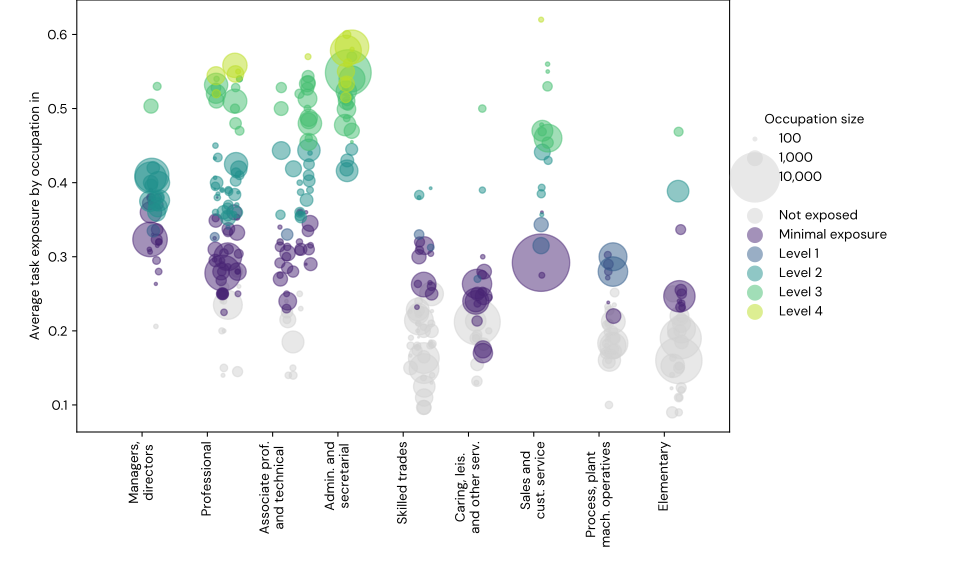
Four findings are worth drawing out. First, administrative and secretarial occupations are the most exposed group — a finding that is robust across studies and scenarios. In this particular area, they account for an outsized share of the workforce, which amplifies the local impact.
Second, professional and semi-professional roles — particularly in IT and finance — face significant exposure under wider scenarios, though for many of these roles the near-term impact may be more augmentation than displacement.
Third, the demographic profile of exposed workers matters for policy design. In our case study, administrative and secretarial roles are roughly 80% female. The correlation between these roles and household deprivation is not straightforward — many workers in these roles are in dual-earner families — but where they are primary earners, or where families face other pressures such as single parenthood, the link to vulnerability is likely to be much stronger.
Finally, the occupations that are less exposed are worth considering. Many lower paid jobs across care, manufacturing and logistics, elementary roles and to a lesser extent customer services, are not particularly exposed to AI in the near term. While this may initially seem reassuring considering the other pressures people in these roles face, the story gets more complicated when we consider the second-round effects of displacement, which we turn to next.
Layer 2: Where do displaced workers go?
Most analyses of AI and the labour market stop at the first layer: which jobs are exposed? But the second-round effects may matter just as much. When a significant number of workers are displaced from one set of occupations, they do not simply disappear from the labour market. They look for other work — and the occupations they flow into come under pressure, even if those occupations are not themselves directly at risk from AI.
To model this, we use the Opportunity Escalator framework, which maps the structure of the labour market as a network of occupations connected by skill similarity. Two occupations are close together in this "jobs-space" if their skill requirements overlap substantially; they are far apart if moving from one to the other would require significant retraining.
For each displaced occupation, we can estimate where its workers would flow based on the skill distance to safe occupations — the assumption being that workers are most likely to move to roles requiring the least retraining. Summing across all displaced occupations gives us a measure of inflow pressure on each safe occupation: the ratio of potential inflows from displaced workers to the existing workforce in that role.
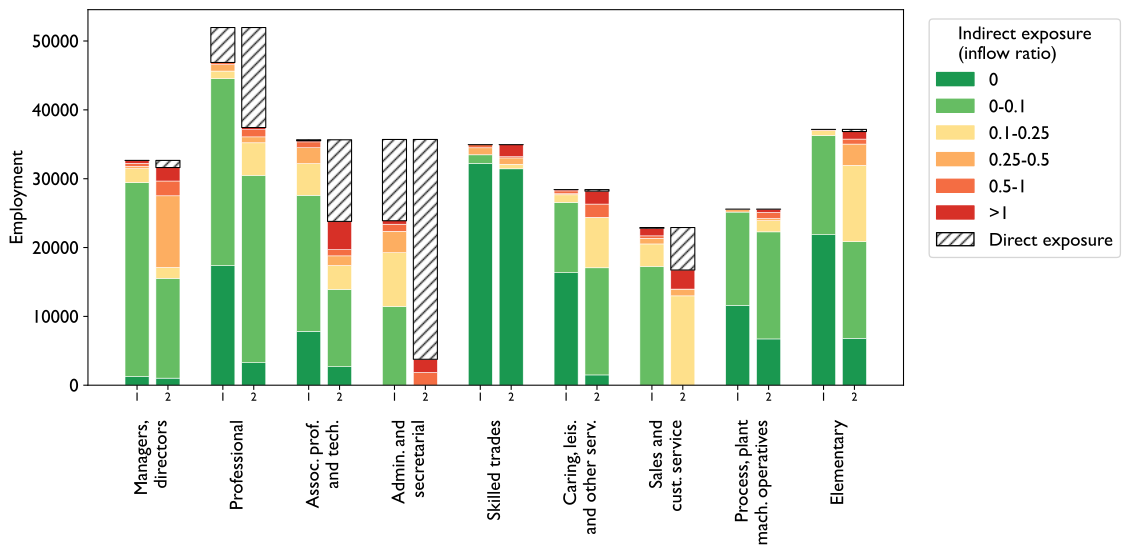
The results reveal dynamics that are invisible in a first-round exposure analysis. Two groups of occupations come under particular pressure, even though they are not directly at risk.
The first is management roles. The incremental skills required for many management positions, over and above those in displaced professional and administrative roles in similar industries, are often modest. As AI takes over the non-routine cognitive tasks that previously differentiated professional from managerial work, the natural evolution is towards human roles centred on oversight and strategic direction of AI resources. This is not necessarily a bad outcome — but it means a significant increase in competition for management positions.
The second is occupations with low barriers to entry — spanning care, sales, customer service and elementary roles. These are invariably lower-paid. The story here is one of displaced workers with few comparable alternatives: when skilled administrative and professional workers cannot find equivalent roles, many will move into lower-paid work, compressing wages in those occupations and making conditions harder for the workers already in them.
This second-round effect has a clear policy implication. It is not enough to focus retraining support on the directly displaced. The workers in "safe" occupations that face high inflow pressure — particularly in care, retail and customer services — may also need support, even though their jobs are not at risk from AI directly.
Layer 3: What are the retraining options?
Understanding which workers are at risk and where they might flow is necessary but not sufficient. The critical question for skills policy is: what does a realistic retraining pathway look like for the most affected workers? And the answer varies enormously by occupation.
For each exposed occupation, we identify the set of safe destinations — roles that are not themselves at risk, that are reachable through recognised qualifications, and that are not already facing severe inflow pressure from other displaced workers. For each destination, we measure the training cost (in hours of total qualification time) and the expected change in pay.
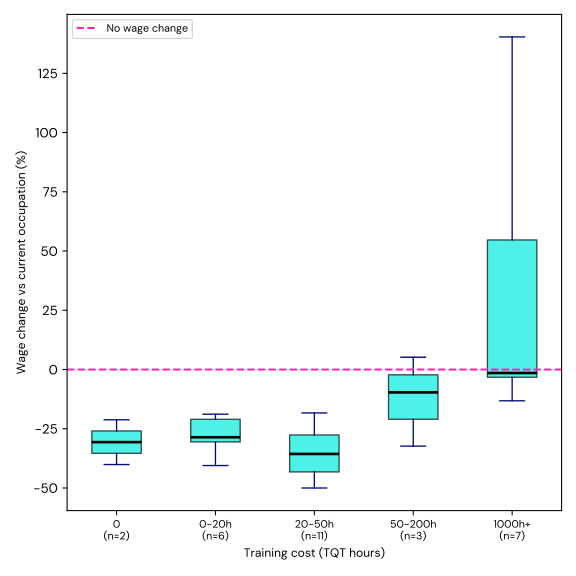
Figure 3 illustrates the dynamics with the case of personal assistants and secretaries — who represent the single largest exposed group in this area. Their skills overlap substantially with other administrative and clerical occupations, but many of those neighbouring roles are themselves exposed. What remains of the safe neighbourhood is primarily lower-paid service roles reachable at low cost, or higher-paid professional roles that require material retraining. Without significant investment, most accessible safe destinations involve a meaningful pay cut; wage-preserving options require training investment measured in the hundreds of hours or more.
The policy implication is not simply that more training should be provided, but that the type of training matters enormously. Short courses that move workers from one administrative role to another are unlikely to deliver durable outcomes if those destination roles are themselves vulnerable. Effective support for the most exposed administrative workers points towards longer retraining pathways into roles with stronger AI resilience.
Implications for regional skills strategy
The three layers of analysis — exposure, spillover and retraining — combine to paint a more nuanced picture than any one of them alone. But the uncertainty about the pace and extent of AI disruption is genuine. No one knows whether the near-term trajectory will look more like our narrow scenario (4% of the workforce directly displaced) or our wide scenario (24%). The most valuable policies are therefore those that retain their value regardless of which scenario materialises.
AI literacy
The single most robust intervention. Whatever the pace of displacement, workers who understand how to use AI tools will be better placed to adapt as their roles evolve — and more attractive to employers who are beginning to re-engineer workflows around AI. This type of training is relatively short, broadly applicable, and well suited to delivery in the context of existing employment.
Education about the changes underway
A lower-cost intervention with potentially high value. Many workers in exposed occupations are unlikely to be aware of their exposure, or of the retraining pathways available to them. Making this information accessible — in partnership with employers and further education providers — allows individuals to make earlier and better-informed choices, reducing the risk that displacement arrives abruptly and requires a crisis response.
Targeted retraining for the most exposed groups
The analysis points to specific, sizable groups of workers for whom the nearest low-cost transition options carry significant wage risk. The case for proactive, targeted retraining support for these groups is strong — but the retraining pathways need to be designed with an eye on where displacement might go next, rather than reacting incrementally. Workers who retrain into occupations that are safe today but exposed under wider scenarios face displacement a second time.
Monitoring and adaptive policy
Displacement is unlikely to affect all exposed occupations simultaneously. Patterns are more likely to emerge first in specific industries or firm types before spreading more broadly. The analytical infrastructure underpinning this kind of analysis can be updated as evidence accumulates, allowing occupational priorities for retraining support to be refined over time. Given the genuine uncertainty, this is often more sensible than committing now to a fixed programme targeted at occupations that may or may not be the first to see disruption materialise. The final article in this series will present evidence on where AI is already showing up in the labour market data and provides a toolset for monitoring the progress of adoption across occupations and regions.
What next
The analysis illustrated here can be tailored to any region in the UK. The occupational exposure assessment, the spillover modelling and the retraining pathway analysis all draw on data that is available at local authority level and above, and the framework can be calibrated to the specific industrial and occupational mix of any area.
If you are responsible for skills strategy, economic development or industrial strategy in a local or combined authority, and you would like to explore what this analysis would look like for your area, please get in touch to arrange a conversation.
This article is part of a series. The first article sets out the economic framework. The third explores what AI means for how firms organise work. The fourth presents evidence on how AI is already showing up in the labour market data.